If you've spent a few summers walking down to the water at the end of Twelfth Avenue South, you know the routine without thinking about it. You leave the house with twenty minutes of daylight left, you park somewhere near the pier, and you find your spot on the sand or the railing before the sky starts doing anything interesting. That routine broke in September 2022, when Hurricane Ian tore through roughly 460 feet of the Naples Pier and dropped about 140 feet of it into the Gulf. It has stayed broken ever since, through three years of funding negotiations, and it will stay broken for a while longer. Construction crews poured concrete for the pier's new support bents twice this summer, on June 26 and again on July 9.
What's easy to miss, if you haven't been paying close attention, is that the sunset itself never actually left. The beach at the foot of Twelfth Avenue South is exactly where it always was, facing exactly the same direction over the same water. What changed is everything around it: how you get there, where you can park, what's waiting for you when you arrive, and whether the thing that made this particular spot special is coming back at all.
What's Actually Closed, and What Isn't
The City of Naples has been precise about the boundaries of the closure, and the precision matters if you're used to winging it. Access to the pier itself is closed for the length of the project, which the city estimates at roughly 18 months from the January 2026 groundbreaking. That closure covers the pier structure, the stairs, the restrooms, the outdoor showers, and the stretch of Twelfth Avenue South west of Gulf Shore Boulevard South. The parking lot at that corner has shrunk along with it. Only the western third of the lot remains open to the public. The eastern two-thirds is fenced off for construction staging.
That's a meaningful cut for a landmark the city itself estimates drew over one million visitors a year before the storm. A lot that used to absorb sunset traffic for the whole surrounding blocks is now running at a fraction of its former capacity, right as summer keeps the evening crowd steady.
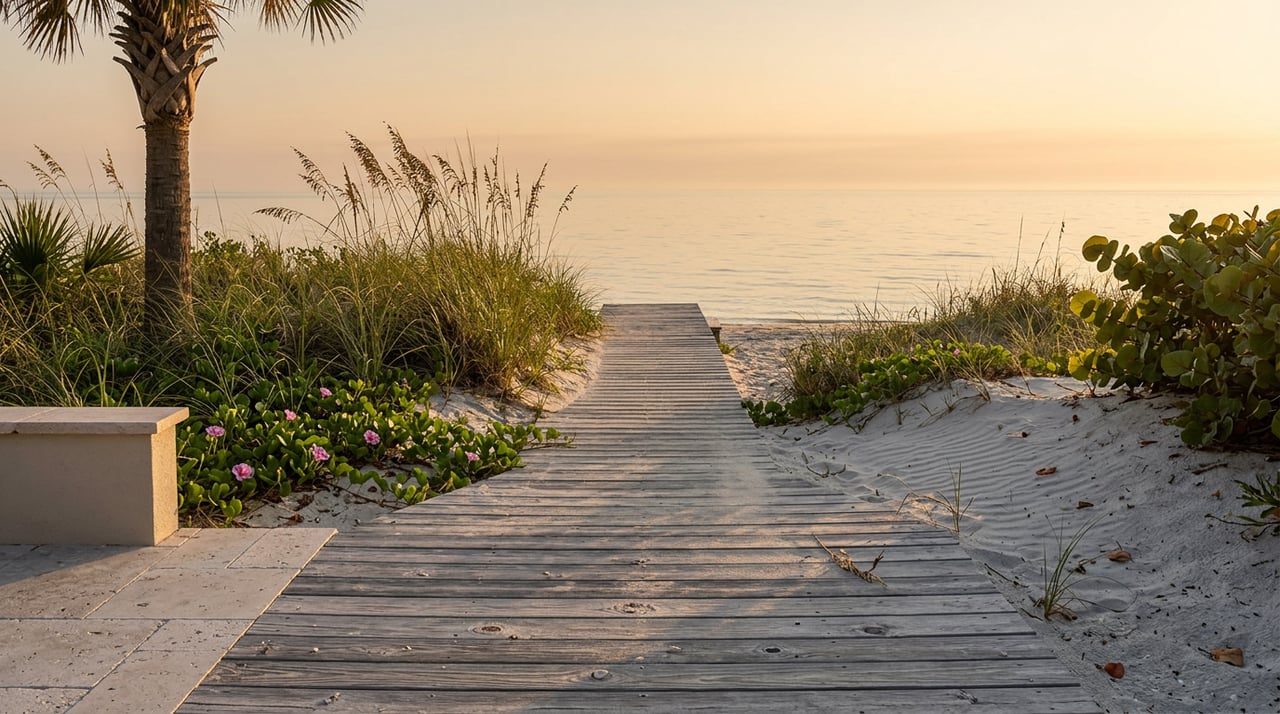
The beach hasn't gone anywhere, though, and neither has the view. The wide public sand at the base of the closed pier is open exactly as it always was, and because Naples faces due west onto the Gulf, the sunset from that beach reads no differently with the pier standing or not. The city has also been careful to keep the beach reachable even with the lot cut down. Two pedestrian bypasses now do the work the parking lot used to do on its own:
- Broad Avenue South at the beach end stays open for the duration of construction, with restrooms on site.
- Thirteenth Avenue South at the beach end is the other permanent bypass, also with restrooms, also open the whole time.
If you've been driving to the old lot out of habit and circling for a spot in that remaining third, the more reliable move right now is picking one of these two beach ends and walking in, the same way regulars have quietly started doing since the closure took effect.
The Benches Went Into Storage, and the Concession Isn't Coming Back the Same Way
Some of the smaller changes say more about what's actually being lost than the headline numbers do. Many of the pier's benches, some of them carrying memorial plaques for people who spent their evenings there, were damaged badly enough by Ian that they couldn't be reused. The salvageable ones were pulled before construction started and are now in city storage rather than sitting where they've sat for years. Anyone hoping to reclaim a bench or its plaque has to go through the city's Community Services department directly, because there's no walk-up or self-service option for that anymore. It's a small logistical detail, but it's also a fairly direct signal that this isn't a repair. It's a rebuild, and rebuilds don't put everything back exactly where they found it.
The concession is where that shows up most permanently. The pier's final design, approved by City Council on March 4, 2026 and drawn up by MHK Architecture, does away with a fixed food service structure entirely. FEMA guidelines prohibit permanent buildings over water, which rules out anything resembling the old walk-up snack bar. In its place, the city has agreed to run electrical power to the pier entrance to support a portable cart, selling water, ice cream, and soda rather than a full menu. City Council framed it as a workable compromise, one that avoids competing with the restaurants a few blocks away on Fifth Avenue South. For residents, though, it means the post-sunset habit of grabbing something cold on the way back to the car is going to look different even after the pier reopens. This isn't a pause in that tradition. It's the end of one version of it.
The new design does add a few things the old pier never had: an underwater camera for viewing marine life, ADA-accessible restrooms, and a police and beach patrol office on land. The $26.3 million project, built by Shoreline Foundation Inc., is targeting roughly 1.5 years of construction, which points toward a reopening sometime around the middle of 2027. Along the way, crews have been documenting the work in stages: a month-long diving initiative in May to clear old debris, including buried pilings left over from the 1990s, an installed construction trestle in June to keep work moving when weather pushes offshore barges to shelter, and the two bent pours completed so far this summer. Fifty-nine of the old concrete pilings even got a second life in April, deployed to expand an artificial reef at Wasmer Reef that the city first established back in 2015.
Where the Ritual Actually Relocated
With the old meeting point out of commission, the evening crowd hasn't disappeared so much as split into two groups, and each one is making a different trade.
Some people have simply stayed close and adjusted their entry point, using the Broad Avenue South or Thirteenth Avenue South bypasses to reach the same stretch of sand they always watched the sunset from. The parking is free curbside, if you can find it, and the tradeoff is that you're sharing two beach-end access points with everyone else making the same call.
Others have moved about a mile north to Lowdermilk Park, at 1301 Gulf Shore Boulevard North. It's a different kind of evening there. The park runs from 5 a.m. to 11 p.m., parking is metered by the hour through an automated gate, and the lot does close when it hits capacity on busy nights. In exchange, you get a full-service beach setup: changing rooms, a concession stand, volleyball courts, and enough amenities that it functions as a destination on its own rather than a workaround. A third option that's picked up some traction is skipping the beach entirely and booking a sunset or dolphin cruise out of Naples City Dock, which sidesteps the parking question altogether by putting you on the water instead of standing at its edge.
None of these fully replace what the pier did for free, which was give the whole stretch of Gulf Shore Boulevard one obvious, unticketed, unlimited gathering spot. What's replaced it, for now, is a set of tradeoffs between free-and-crowded, metered-and-amenitized, or paid-and-waterborne. That's not a downgrade exactly. It's just a more complicated decision than the one people were used to making without thinking about it.
What Comes Back, and What Doesn't
By the time the new pier opens, likely sometime around the middle of 2027, it will be taller, better anchored, and better equipped to survive the next storm than the one Ian took apart. It will also be a genuinely different place to spend an evening: no snack bar, no fixed food service of any kind, restrooms rebuilt from scratch, and a marine camera where there wasn't one before. The benches that made it back from storage will likely find their way onto the new structure, but the concession habit that generations of residents built around that walk is closing out with this rebuild, not reopening with it.
For now, the honest version of the story is that the sunset held up fine. It's the logistics around it, and a few of its smaller traditions, that didn't come through the storm intact. Knowing which beach end to walk in from, and which habits aren't worth waiting for, is the kind of thing that only becomes obvious after you've lived a few seasons of it.
That's the same kind of granular, block-by-block familiarity that goes into understanding what a property here is actually worth, not just what a listing sheet says about it. If you're weighing a move within Naples, or wondering how a stretch of coastline like this one holds its value through a rebuild like this, Maureen Sexson has spent decades reading these neighborhoods closely enough to know which changes are temporary and which ones are permanent. Reach out when you're ready to talk through what that means for your own plans.